Tampilkan postingan dengan label you. Tampilkan semua postingan

Minggu, 24 Juli 2016

About something you really need

Something you might want to think about, a bit of asshat humor, and in the "Wrong then Wrong now" department...

I dont, as a rule, make pronouncements of the "everybody needs to have this" sort but every boat really needs some sort of emergency rudder that works if youre sailing out of cellphone range.

Ya think?

Fact is, building an emergency rudder that works does not cost a lot or take much skill and all of the information you need is available here for free.

That being said, there are folks who just dont GROK the DIY vibe or who are unwilling to spend the sort of silly-expensive costs of having a custom emergency rudder fabricated... Luckily for these folks there is a new emergency rudder that seems to make a lot of sense called the OceanSteer Emergency Rudder.


While not exactly cheap compared to a DIY affair it is much more reasonable than a custom fabrication. Better yet its designed to fit into a couple of flat packs so can fit into a cockpit locker or under a berth which makes a heck of a lot of sense. Definitly worth checking out.

Listening to Motion City Soundtrack

So it goes...
Read More..

Kamis, 21 Juli 2016

Lugsail Performance Better than you may imagine

Ive lost count of the number of times that Ive read comments from people saying that lugsails may be simple to rig, easy to reef, and convenient to use, but that there is a high price to be paid for the good points, and that the price is poor performance to windward - especially when sailing without a jib and/or staysail.

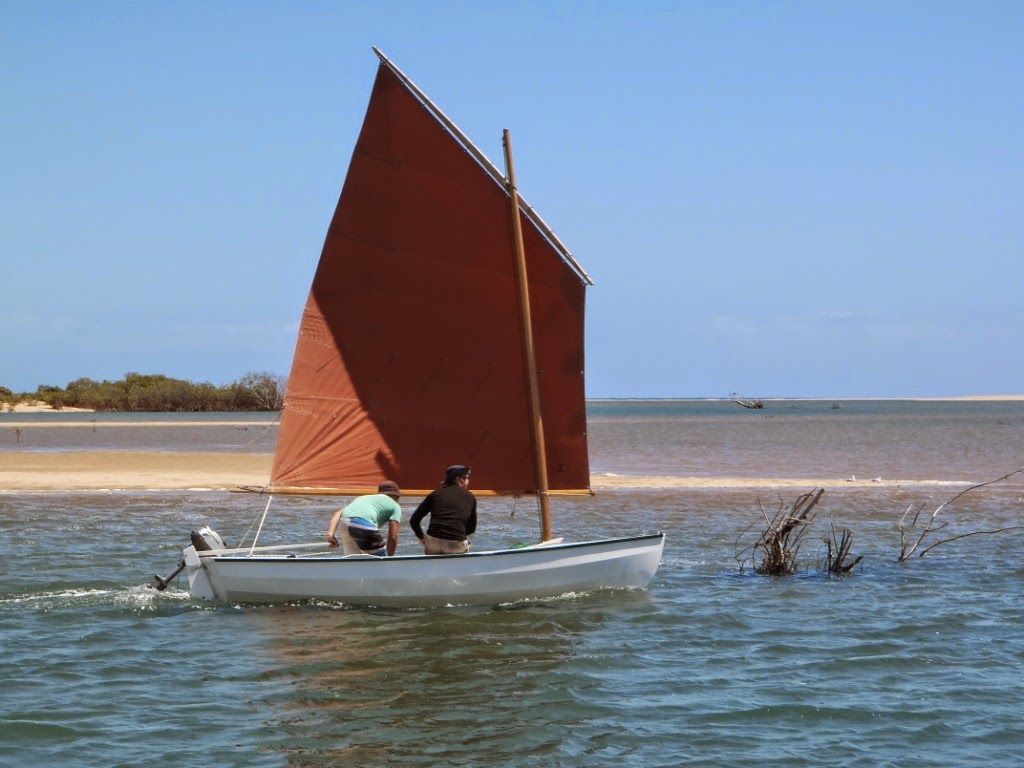
Concentrating hard on getting our 45 yr/old dinghy up to windward in order to weather a sandbar, using a balance lug rig without a jib.

The prejudice against lug rigs is made worse because so many people are disturbed by the asymmetry of having the yard, boom and sail on only one side of the mast - to most theoretical observers it just seems wrong.

I admit to having suffered from the same prejudice, and the only thing that forced me to attempt an asymmetrical rig was my interest in Chinese lugsails. Back in 1984 I rigged my boat with a Chinese Lugsail (a.k.a. Chinese Junk rig) just so that I could learn about the performance and operation first-hand.


This rig proved to be an exceptionally good cruising rig, but it required lots of development work with the shaping of the battens before starting to really sail well. For heavy weather sailing in tough conditions, Ive never had anything better. However, it was heavy and complex for use on a dinghy.

Well, despite the fact that professional seamen used lugsails for centuries, todays sailors seem to find it very difficult to overcome their feels regarding asymmetry and the perception of  poor windward performance.

Recently a group of sailing friends spent a few days at Lake Wivenhoe in south-east Queensland, Australia, and some interesting video has emerged (videos courtesy of Paul Hernes) showing Rick ODonnell and John Shrapnel sailing against each other in Ricks Iain Oughtred-designed Fulmar and John in the Periwinkle I designed and built for him. On this particular day Rick had a single reef tied into his mainsail, and John had removed his 52 sq.ft mizzen sail altogether, so both boats were carrying reduced sail area.

Ricks Fulmar is somewhat longer than designed, as I believe that he increased the station spacing during construction, and I think she is about 18 ft LOA. Periwinkle is 17 ft LOA and has a cut-away forefoot, so she is handicapped by a significantly shorter LWL than Ricks Fulmar.

In the video below, you can see for yourself how the lugsail performs against a more conventional rig. Note that the lugsail is on the "bad tack" - i.e. the sail is wrapped around the mast, which is a frequently heard argument against the practicality of the "asymmetrical" lug.


So, dont be put off a lugsail just because you feel uncomfortable about asymmetry, or because you think they dont perform well to windward. Lugsails are cheap and easy to make, simple to handle, a breeze to reef, and very quick to rig and strike. The easier a boat is to rig and un-rig, the more likely it is that you will use her. In a later post Ill show you how you can improve the windward performance of the lugsail even more, using nothing more than a short length of V.B. cord.


Read More..

Minggu, 19 Juni 2016

So what do you really get for that extra 425K

Very interesting, well worth a read, and a good point being made...

Reading a recent issue of Sail magazine I was admiring the look of the new Rustler 36 and, thinking to myself, what a nice cruising boat it would be. Well, right up till the point that I saw it was around $450K for a "sailaway" version.

Which is not to say that the Rustler is not a very, very nice boat but an over half-million dollar, old-school design boat by the time you get it off the dock for something that performs like and will take you to the same places as an old CAL 36 (or insert your favorite older classic plastic 36 here) you could buy for less than $15K.

Throw in a smart $10K bespoke refit and anchor it next to the Rustler 36 and 99% of folks who dinghy by wouldnt be able to tell the difference between the two...

Maybe its just me but I just cant see any way that extra $425K spent would make my life any better.

Just saying.

Listening to a hurdy-gurdy man...

So it goes...
Read More..

Jumat, 03 Juni 2016

a project you might want to check out during 2016

Some exciting stuff, regarding those dire predictions, and something well worth the read...

Someones been busy.


I expect youll be able to find out more as it develop over at Boat & Koad.

Listening to a plethora of good covers

So it goes...
Read More..

Sabtu, 19 Maret 2016

Just one of many reason you should be reading Webb Chiles

About that Columbus dude, a handy primer on political correctness, and some needful reading about that Paul Theroux editorial...

Webb Chiles making a fair amount of sense over on his blog!

"I have sailed more engineless miles than some who have built their reputations and made a religion of it. I had EGREGIOUS built without an engine. CHIDIOCK TICHBORNE did not have one. The diesel on RESURGAM died on the Caribbean side of Panama and we sailed all the way to Australia before we replaced it. I’ve never powered more than an hour here and there at sea, and then usually only to stabilize a boat being thrown about in leftover seas with no wind. That you have to power through the doldrums is simply not true. I’ve crossed the Equator now, I think, thirteen times without motoring. If you are a sailor and have a boat that sails well, you only need an engine for the last hundred yards/meters in harbors that are set up with the expectation that all boats are powered."
                                                                                          
Listening to the Silversun Pickups

So it goes...


Read More..

Selasa, 23 Februari 2016

How do you determine the number and dimensions of staves in a Birds Mouth Mast or Spar


Birdsmouth is the word in the shop, lately. We have several orders for birdsmouth masts and spars that are in progress. I have been working hard at nailing down the process to be able to make them efficiently and to a very high standard and feel very excited about how it is all going. The Landing School of Boatbuilding has asked me to to give a talk/demo on making things birdsmouth style, so Ive been pressed to improve our webpage on birdsmouth spars as well. On the page is my procedure for determining the number and dimensions of staves in a birdsmouth spar. Gaeten Jette, a featured contributer to Duckworks magazine on the topic of Birds Mouth Spars, generously helped me customize the online calculator for my use and students use. I hope you find it helpful, too.

We make two styles of Birdsmouth spar, using symmetrical staves (most common) and asymmetrical staves, which when done correctly will yield a perfect octagon and a spar that is slightly stronger and quicker to make. I decided to apply this type to making an ultralight kayak paddle shaft.


I am pleased with the results. The biggest hold up was fitting the plugs in the scoops that will take a ply-composite or a carbon fiber blade, which is already something we produce for our wood/composite, high performance oars.

With that part of the process ironed out it really is just a matter of setting up the operation to produce these paddles after some testing. This one will go to some paddler friends who will take the design on the seas and really test it out. Hopefully, sometime this summer the results will come in and production will begin. Ill leave you with the best part of making new things: breaking them with a hammer. We test most spars this way to make sure that things break the "right" way. That is, in a proper glued structure, the wood should always break before the glue joint does, otherwise there is a problem. Happily, all our spars have been breaking the "right way" in the shop so we know they wont break out on the water.

Read More..

Minggu, 07 Februari 2016

Star 45 Model Sailboat GET THAT TOPPING LIFT RIGHT if you wanna go fast !

By Phil Geren

Of all the go fast stuff I have learned from tuning experts over the past year, the most valuable, and the thing that has provided the most additional boat speed for my 13#-3.5oz Star 45 (the "Fat Lady") is how to get the Jibs topping lift set right. I am doing much better in my racing since learning this.

The curve of the leech of the Jibsail MUST resemble as closely as possible the curve of the leeward surface of the Mainsail when sighting from the foredeck. If the Jibs leech is flatter or fuller your boat will not attain its speed potential while beating and reaching.

The topping lift enables you to get the curves aligned. Tightening the topping lift makes the Jibs leech fuller, more curved. Loosening the topping lift makes the Jibs leech flatter. With a little practice you can get the curves to be identical.

Heres how:

Pull the Mainsail in to the beating position; Swivel the Jib boom with your finger (apply only lateral force, no upward or downward force on the Jib boom) so that when you sight from the foredeck and look up and down the curve of the windward surface of the leech of the Jibsail it is superimposed on the curve of the back (leeward) surface of the Mainsail.

Are the curves identical? If not, is the Jibs leech more curved?
If it is, loosen the topping lift.

If the Jibs leech is flatter, tighten the topping lift.

Make small adjustments. This is very sensitive, and you can get it right if you persevere.
Recheck the need for adjustment after every few heats of racing or if you change anything else.

On sailboats EVERYTHING is related to everything else, and you will need to readjust periodically to maintain your added speed.

Dont have a topping lift? INSTALL ONE NOW! You wont believe the improvement!
Read More..
 
Wooden Boat - Powered By Blogger