Tampilkan postingan dengan label what. Tampilkan semua postingan

Rabu, 20 Juli 2016

Star45 What is a hull Daves construction categories unofficial

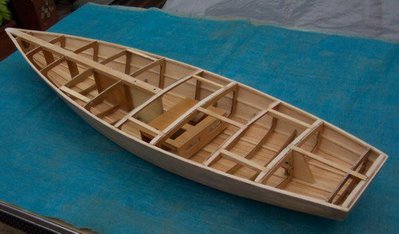
Model Sail Boat Building, How To Build A Wooden Star45 R/C Sailing Model: What is a hull ? and construction categories
A composite hull:
a hull constructed of wood and covered with reinforced plastic (cloth impregnated with resin).

OR:
a hull constructed using a laminate (sandwich) consisting of reinforced plastic (cloth impregnated with resin) on two sides of a core . Core materials may be foam or wood.
Read More..

Minggu, 19 Juni 2016

So what do you really get for that extra 425K

Very interesting, well worth a read, and a good point being made...

Reading a recent issue of Sail magazine I was admiring the look of the new Rustler 36 and, thinking to myself, what a nice cruising boat it would be. Well, right up till the point that I saw it was around $450K for a "sailaway" version.

Which is not to say that the Rustler is not a very, very nice boat but an over half-million dollar, old-school design boat by the time you get it off the dock for something that performs like and will take you to the same places as an old CAL 36 (or insert your favorite older classic plastic 36 here) you could buy for less than $15K.

Throw in a smart $10K bespoke refit and anchor it next to the Rustler 36 and 99% of folks who dinghy by wouldnt be able to tell the difference between the two...

Maybe its just me but I just cant see any way that extra $425K spent would make my life any better.

Just saying.

Listening to a hurdy-gurdy man...

So it goes...
Read More..

Senin, 30 Mei 2016

What is a hull and construction categories

Dave Mainwarings definitions

HULL defintion of:
The outer shell, including frames, ribs, interior bulkheads, exclusive of masts, rigging, deck and equipment.


"bare hull" defintion of:
A model boats outer shell, EXCLUDING, ribs, interior bulkheads, exclusive of masts, rigging, deck and equipment. Example. A fiberglass hull as pulled from a mold.

--

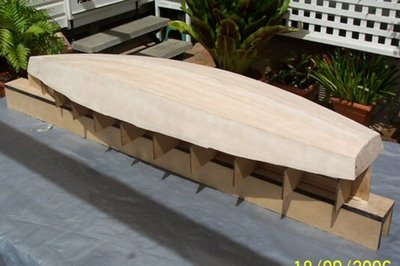
A wooden hull:
one constructed of wood (including plywood).


--
A glass hull:
one constructed of reinforced plastic (cloth impregnated with resin). Nominally referred to as a fiberglass hull.

--
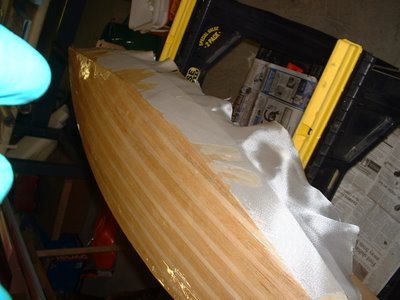
A composite hull:
a hull constructed of wood and covered with reinforced plastic (cloth impregnated with resin).
OR:
a hull constructed using a laminate (sandwich) consisting of reinforced plastic (cloth impregnated with resin) on two sides of a core . Core materials may be foam or wood.
Read More..

Selasa, 10 Mei 2016

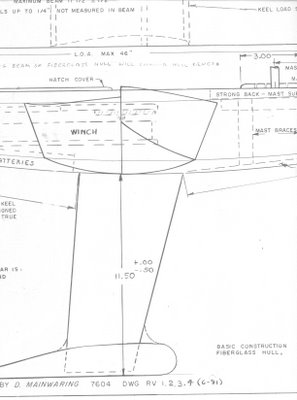
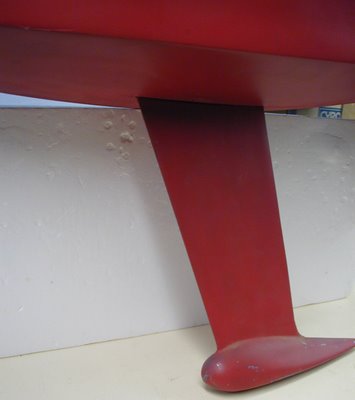
What about keel shapes and keel bulb design


The Star 45 R/C Model Sail Boat - Builders Journal

"Dave Mainwaring"
Someone asked about shapes and sizes.

I like keels that resemble in some manner the "Scheel Keel". Flat bottoms help fight heeling. My version was based on my sailing in waters with lilies and pond grass that snagged torpedo shaped bulbs. I liked being able to back away and have the crap slide off the keel.


http://photos1.blogger.com/blogger/5587/620/400/Sirius%2045%2006.jpg


http://photos1.blogger.com/blogger/5587/620/400/Sirius%2045%2002.jpg


Here is a photo of the original Mainwaring Keel and Mainwaring Bulb


http://photos1.blogger.com/x/blogger/5587/620/400/353321/Sirius45Keel.jpg

Read More..

Senin, 18 April 2016

a quick note on what it takes to be happy

About that so-called "Persecution", a little situational awareness, and some old good advice...

I was reading an old cruising log the other day detailing a familys cruise from the UK to the Med then on to the Caribbean and back to the UK and it reminded me just how much cruising has changed in the last thirty years.

They didnt have electronics of any sort. Not even a radio. Lighting was kerosene as was the stove and there was no ice box with the more perishable provisions being simply kept in the bilge.

Their boat (an Eventide) was all of 26-feet for the four of them with not so much an inkling of mutiny...

Oh yeah, they also seemed to be having a great time in the process.

Listening to Kevin Kinney

So it goes...
Read More..

Sabtu, 19 Maret 2016

What the Saints did Next

The Saints are the people who live on St Helena Island, a remote island in the middle of the South Atlantic Ocean. They live on a mountain of rock that comes straight up out of the ocean, with steep cliffs all round and nary a beach to be seen. The terrain is very convoluted, with deep valleys and mountain passes. Until now, the only way to reach St Helena has been by boat or ship but soon an airport will be completed, making the island more accessible to others and opening up the world to the islanders. This is an interesting place to visit on Google Earth, to see how remote and inhospitable it is. The new airport can also be seen; consider the mammoth task that it must be taking to create it with the minimal resources available on the island. I imagine that much equipment and material has been shipped in over the past few years to accomplish this.
Saloon view of "Black Cat". Photo courtesy of What The Saints Did Next.
St Helena is the finishing point for the Governors Cup Yacht Race, sailed from False Bay Yacht Club in Simonstown on the western side of False Bay, South Africa, every two years. It was also the place to which Napoleon Bonaparte was banished for his second imprisonment. It was far enough away from anywhere else that he was not able to get up to any more mischief.

What The Saints Did Next is the blog for the island, which helps to keep the world up to date with whatever is happening on the island. The blog has a great post about "Black Cat" and her win in the most recent edition of the race. It includes an interview with the crew about the race and life aboard, as well as a bunch of really nice photos of "Black Cat" and crew.

I hope that I can be on "Black Cat" for her next voyage in this race. Visiting St Helena is on my bucket list as a place to visit. An ancestor of mine and the first Dix to settle in Cape Town arrived from St Helena. What he was doing there I dont know, possibly a soldier guarding Napoleon.

"Black Cat" is the prototype of my Didi 38 design and forerunner of all of my radius chine plywood designs. Visit our website at http://dixdesign.com for more info on my designs.
Read More..

Jumat, 18 Maret 2016

What I wish Santa would bring me

A little bit of interesting history, a lot of truth in faux publicité, and in the "lies have consequences" department...

This is seriously cool!


The problem with all the boat-friendly washing machines Ive come across is they really have no real or decent rinse/spin capability which everyone knows is the heinous part of doing laundry on a boat. The Drumi, on the other hand, looks like (just maybe) it might actually do the job. Its a chunk of change but with a small load at a Caribbean laundromat costing $3.50 or more these days it would pay for itself in a reasonable amount of time and dispense with the dreaded evil trip to the laundromat blues. So, color me interested.

Listening to the Staples Singers

So it goes...
Read More..

Rabu, 03 Februari 2016

What a difference a line can make

In June this year I wrote part 1 and part 2 of a post on Humber Yawls, in which I mentioned a design Ive been working on for my own use.

Nugget with her gaff-headed cat rig with a tiny jib set flying...

...and Nugget with her yawl rig. Some people may say this is a ketch rig because the mizzen mast is in front of the rudder, but it is very difficult to have a mizzen mast behind a transom-hung rudder! The rig is a yawl in functional terms, as the mizzen is more for balance than for drive - although it will drive strongly on some points-of-sail.
 This set of lines has been lurking in my head and on the computer since September 2011, and Ive drawn at least nineteen major versions, and countless more minor variations. Usually I get what I want in only a few intense sessions of hull modelling, but this one just wouldnt let me peg it down! You could be forgiven for saying that I have been over-cooking it, and that I should have accepted what I showed in the previously mentioned posts - or that I should have given up and moved on to something else.

??
Lines Plan of the hull shown in the previous posts - close to being good, but just not right...


Perspectives of the same hull
A few nights ago while lying in bed trying to sleep, I finally cottoned onto what I thought had been causing the problem, and the next morning I made the changes and I think Ive finally got it right - here are the new drawings...

Lines plan of the modified hull - can you spot the difference?
Well, there is no difference at all in the underwater lines, which is good because I like them very much and at this stage of my development as a designer, I cant think of how I could improve them for what I have in mind for the boat.

The only difference is that I have moved the lowest point in the sheer aft by 370mm (about 14-1/2") and lowered it by 42mm (1-5/8"), but the boat has changed from being an ugly duckling to a beautiful swan in my (biased) eyes.


Perspectives of the modified hull - a tiny dimensional difference in the sheer line, but a huge difference in the aesthetics.
So, what does all this mean in practical terms? For one thing, it means that I will probably build this boat whereas the preceding versions worried me enough for me to loose enthusiasm. Maybe the boat will get looked after better, and last longer, because someone thinks she looks beautiful long after Im gone. To me it shows the value in paying attention to detail and not just accepting something as being nearly good enough.

But the most important thing it proves to me is the astonishing effect that tiny variations in shape and proportion can have on a three-dimensional object.
Read More..
 
Wooden Boat - Powered By Blogger