Tampilkan postingan dengan label design. Tampilkan semua postingan

Jumat, 01 Juli 2016

Maïca and her sisters a classic Illingworth design

There are not many ocean racing characters whose exploits and achievements rival those of Captain John Illingworth. He was already a well-known and successful yacht racer before the war, but it was in the 1940s and 50s that he virtually dominated the British ocean racing scene, as well as being hugely influential in the development of the sport in other countries, especially France and Australia. (photo: Mandragore, a transom stern Maïca class)
His most famous yacht, Myth of Malham, was nominally designed by Laurent Giles, but it is no secret that Illingworth himself conceived the general outline of the boat, with its abruptly short ends, relatively light displacement and, above all, its groundbreaking rig with big masthead foretriangle and high aspect ratio mainsail. Jack Laurent Giles begged to be allowed to draw longer overhangs, but was firmly overruled. He complained that the proposed mainsail was too short on the foot and looked more like a flag than a sail, but Illingworth insisted, and Myth of Malham went on to be one of the most successful ocean racing boats of all time.
In 1958 Illingworth opened his own yacht design business, in partnership with Angus Primrose. Together they created some of the most attractive and weatherly boats of the era. Illingworths role was to conceive the design in general, the rig, and the details of deck and interior layouts, while Primrose gave the hulls their sweet and efficient lines for speed, good seakeeping and beauty. (photo: Saba, a superb example of a counter stern Maïca)
Many of the firms early clients were French. Illingworth spoke fluent French and loved the country. He encouraged and assisted in the founding of the enormously influential Glenans sailing school, where hundreds of young Frenchmen learned to sail – and to become instructors themselves. He was commissioned to design a yacht for the Glenans school, the building of which was put under the supervision of Philippe Harle who worked at the Glenans at the time. This experience so stimulated Harle that he immediately gave up his job at the school and set up as a yacht designer himself.
The first of what became known as the Maïca class was commissioned by French yachtsman Henri Rouault who had admired Illingworths earlier successful racer “Belmore” and asked for a smaller version. She was built by Burnes of Bosham and launched at Easter 1960. At the suggestion of Rouaults sister, a nun, the boat was named after her convents former Mother Superior, a decorated heroine of the wartime resistance, who was known by the nickname “Maïca”. (image: drawings for the transom stern Maïca)
The original Maïca, like the Belmore design, had a transom stern. She was so admired and so successful, winning the RORC Class III championship in 1962 that soon further examples were built in Britain and in France, but when Illingworth sold the plans for the Maïca to Constructions Mécaniques de Normandie at Cherbourg, Felix Amiot, the owner of the yard, insisted that the design should be modified with a counter stem. Apparently this was because M. Amiot wanted a Maïca for his own personal use and he preferred the elegant look of a counter stern.
So Illingworth and Primrose produced plans for a “Maïca à voûte” (counter stern) and in 1963 CMN started to build this version employing a novel method of construction that made series production viable - cold moulded mahogany. (image: drawings for the counter stern Maïca class) A first lightweight layer of 1cm planks was laid longitudinally over formers, then two diagonal layers of planks, each 4cm wide, at right angles to each other. When the glue had cured the hull was simply lifted off the formers and turned right way up for decking and fitting out.
CMN built 38 Maïca class yachts, about half of which are known to be still sailing and in superb condition. (photo: Maïcas awaiting delivery at the CMN yard in Cherbourg) The CMN Maïcas were mostly sold to French clients, (one was ordered by the Greek ambassasor to Paris), but many went to customers from Britain and other countries. Some of these boats were among the most famous offshore racers of their day - and many were scoring notable wins even ten years after the introduction of the class
With so many international racing successes and long voyages, the class also made a name for itself in Mediterranean waters and it was not long before a couple of Italian yards obtained licences to build slightly modified versions. One Italian version, of which I believe over a hundred examples were built, was in GRP with a modified fin keel and skeg underwater profile.


Maïca class by Illingworth and Primrose

LOA: 10.08m (transom), 11.06 (counter)
LWL: 7.32m
Beam: 2.74
Draft: 1.74
Displacement: 5300Kg (approx)

(photo: The elegant stern of one of the counter stern Maïcas, recently sold by Sandeman Yacht Co.)

Links:
Class Maïca (Acknowledgements to this French website for much of the history and most of the above photos)
Saba - a French owned Maïca.
If you want to sail a Maïca, see Sabas cruising and regatta programme
Read More..

Kamis, 09 Juni 2016

Drake 19 Design Work Continues

Drake 19 Rowboat Project

Oar-and-Sail Tandem Rowboat and Cruiser with downwind sail

Drake 19 Rowboat with "squgsail" for off-the-wind sailing. Drake is primarily a rowboat (no board; rudder not shown above)

The 19 is essentially a stretched Drake 17 with the hull lines tweaked to support tandem rowing and fast, camp-cruising. The boat is being modeled currently and the hull lines tested next with a quarter scale model. Once the hull form is all set, the interior will be modeled and strongback prepared for kit-building. Im excited about this boat and look forward to setitng up the first builder. I always offer an intro discount for the first builder as they are providing me with the help of documenting the build and providing feedback. If interested in being the first builder, please let me know. You can be experienced or a beginner, but one project of experience is helpful as is some good ole problem solving abilities. The discount is generally 25-30% and the plans are free to the first builder.

Preparing the quarter scale model for the Drake 19. 

Read More..

Rabu, 08 Juni 2016

a very cool lifeboat dinghy design

A good cause for October, some pretty horrible news, and in the "I knew it was bad but this really sucks" department...

Roberto Barros and company have a new aluminum dinghy/lifeboat design that is really worth checking out.

Designed to fit on the deck of the Kiribati 36, plans come free when you buy plans for the Kiribati or other larger Barros alloy designs. Of course, you can also buy the plans if you already have a boat.


Theres a lot more information over at the Barros website and you really should check it out...

Listening to Rayland Baxter

So it goes...
Read More..

Selasa, 10 Mei 2016

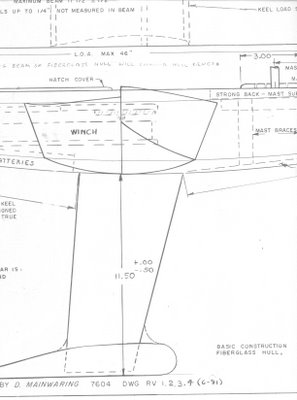
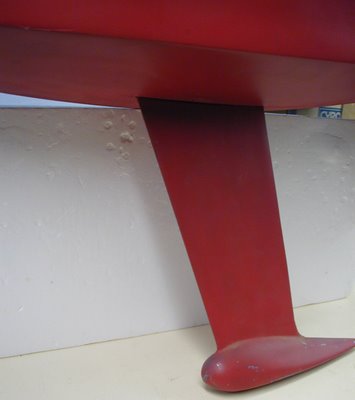
What about keel shapes and keel bulb design


The Star 45 R/C Model Sail Boat - Builders Journal

"Dave Mainwaring"
Someone asked about shapes and sizes.

I like keels that resemble in some manner the "Scheel Keel". Flat bottoms help fight heeling. My version was based on my sailing in waters with lilies and pond grass that snagged torpedo shaped bulbs. I liked being able to back away and have the crap slide off the keel.


http://photos1.blogger.com/blogger/5587/620/400/Sirius%2045%2006.jpg


http://photos1.blogger.com/blogger/5587/620/400/Sirius%2045%2002.jpg


Here is a photo of the original Mainwaring Keel and Mainwaring Bulb


http://photos1.blogger.com/x/blogger/5587/620/400/353321/Sirius45Keel.jpg

Read More..

Senin, 09 Mei 2016

Navigator John Welsford design

Fellow blogger Robert Ditterich has reminded me to include one of my favourite open boats the Navigator, designed by John Welsford this pretty and traditional looking boat has proven to be a highly successful, fast and capable open cruiser.

The words and pictures are of Roberts own Navigator Annie, the build log of which is chronicled on flickr.


LOA 4.5m 14ft 9in
Beam 1.8m 5ft 10in
Weight 140kg 309lbs
Sails 12.6sqm 136 sqft


Robert explains - Available as a sloop or yawl rig the latter seems to find favour with builders and sailors due to its flexibility and frankly it is a very handsome rig.

Annie is one of hundreds of Navigators dotted around the globe, and while not all of them spend endless days cruising placid bays, and camping on impossibly beautiful beaches, plenty have done that, and all are capable of making many of our boating fantasies real.


Mine was launched towards the end of our good weather, so experiences are limited and action shots are scarce. But I have to say that I was surprised and very pleased with Annies manners since I first took her out. The most surprising thing was her initial stability. When the first gusts caught me, I was amazed to be still within the cockpit, and not making use of the tiller extension. I dont mind sitting out, but it is wonderful to have a choice about these things in a dinghy.

Building a Navigator has the distinct disadvantage though, of making it harder to justify building another boat, because it is attractive and practical and flexible, and it gets you cred with the stink boat people at the ramps. Every outing will create at least one good conversation with a total stranger. So another boat often seems to be just a gratuitous, superfluous thought. A pity, if you like building as much as sailing. Some of you might see me wriggle and squirm as I try to rationalise my way out of that one.


JW got something very right when he drew Navigator, and for my money the most important thing he got right was to make it possible for so many people to be able to build such a good boat themselves. All strength to anyone who empowers ordinary un-skilled people to get away from the TV, into the shed and to make something wholesome and exciting and capable of bringing people to-gether in a natural setting.


Robert a who also makes violins professionally has built Annie to an incredible standard, the pictures which show the plank stringers and the planked up hull above has an almost sculptural quality about them. I also agree with Roberts comment about encouraging others to build, while not many of us can build to his exacting standards we can all be encouraged by his enthusiasm and enjoyment of building.

Robert is also author of a book "Something About Navigator" which is available as a download and thankfully for those of us who still prefer a volume we can brush with our fingers as we work along the book shelf a printed version.

Read More..

Rabu, 04 Mei 2016

Not about boat design or boatbuilding

Just another depressing water story, policing for profit, and Badtux has a solution...

I just listened to a great podcast about cooking and suchlike. I expect, if you have a spare hour to kick back and listen, you will enjoy it as well. That said, it really has no boat content whatsoever.

Well, actually, it sorta/kinda does in a sorta kinda way...

Listening to the Scandals

So it goes...


Read More..

Selasa, 26 April 2016

Design Evolutuion

Naval Architecture and small craft design as we know it today is a relatively new process in human terms. By that I mean the design of boats by the use of paper drawings and, more recently computer modelling. I do not know enough about the detail of the history to make any definitive statements without research, but broadly speaking I think that the last 300 years would just about cover the span of "paper" design.

Boatbuilding (and presumably design) in present day Vietnam. Photo courtesy Bill Bradley

Once again in general terms, small craft design lagged behind when it came to plans drawn on paper as the first step in producing a boat. Well into the twentieth centuary, and in fact right up until today, small boats have been designed and built by eye and intuition, coming together and evolving on the builders strongback.

Ive got plenty of boat designs in my own portfolio, but Ive only published a few. When I say designs, what I really mean is that I have a large number of lines drawings and finished computer models (even some carved half-models, of which the current computer models are a modern equivalent). Although the modelling of a hull, calculation of the hydrodynamics, and the drawing of the lines represents a large part of the creative side of boat design, the really time-consuming part is the detailed drafting of the building plans. Much modern design software deals with the detailed structural drafting semi-automatically, but I do my drawing manually, line-by-line in a simple 2D CAD program. Effectively, it is simply drawing in a conventional manner, but using an electronic drawing board - at least it makes erasure much cleaner!

This photo shows me making the lines drawing of Phoenix III. These days I do it electronically. 
For a number of years now I have felt uncomfortable about the number of plans being pumped out around the world for commercial gain. I know that people are always after something just a bit different, but in years gone by, existing designs evolved to meet the requirements of the customer rather than the market being flooded with new designs just for the sake of having a new design. The result was that bad elements were designed out and good elements were improved upon, giving rise to boats which were better and better suited to their intended function. It is with that in mind that I have been holding back on publishing extra plans.

In the last couple of weeks, I have been approached by a customer who had bought a set of plans for my Phoenix III design, asking whether the boat could be built using the glued-strip plank method.

The very first Phoenix III on launching day. Photo Rhonda Lillistone
Now, I designed Phoenix III from the very outset to have five wide planks of plywood planking making use of the excellent glued-lapstrake building method. My idea was to make use of the cross-grain strength of marine plywood, and to capitalise on the width of the available material. Also, I was aware that many people are intimidated by the thought of making a large number of planks, so I felt that five wide planks would provide a good compromise between a rounded lapstrake hullform and ease of building. The resulting boat has been very sucessful, and Im quite proud of the overall design.

Phoenix III has several different rig options - this is the balance lug, which sets on exactly the same mast as the sprit rig. Photo Paul Hernes

Because I designed Phoenix III for five wide planks per side, I drew the bulkheads and molds with a number of flats to take the individual planks. This makes it much easier for an inexperienced builder to determine the lay of the planks and makes spiling (the determination of the plank shape on the flat) much simpler. The problem is that it would not allow the customer to build the boat using the glued-strip-plank method. I was tempted to tell him to use a spline to simply draw a curve through the points of the flats on all of the sections, but I wasnt convinced that the resulting shape would be fair.

A half-section through the hull, showing how the wide planks lay against flats on the bulkheads and molds.
What I ended up doing was to import the existing hull shape into the DELFTship Professional which I currently use for hull modelling, and then altered the entire hull from one with five flats per side, to one with a fully rounded, smooth hull surface.

Phoenix III perspective

Phoenix III perspective

Phoenix III lines plan


I have since carried out a similar modification to my Periwinkle design, which was drawn in the same way as Phoenix III.

Periwinkle on launching day. Photo Paul Hernes
One of the side benefits of this process has been that I have been able to make variations to the hull shapes where thought beneficial. In the case of Phoenix III I left her exactly as designed with the exception of making the hull smoothly rounded. But for Periwinkle, I increased the height of the bow very slightly and filled out the sheer line forward in plan view a little. This was made possible because the smoothly rounded hull does not have to comply with the limitations of developable plank shapes, which is necessary with the five plank hullform.

So, here is an example of improving (hopefully) existing designs with small, incremental alterations carried out where experience indicates they may be beneficial.

Having said all of this, I encourage anybody who feels the urge to have a go at designing their own boat. Experience begins at the beginning!
Read More..

Senin, 22 Februari 2016

New Plywood Garvey Design

I have been working intermittently on a new 16ft design for awhile, the start of a range of small powerboats for protected water use. The design is still a way off being complete but the prototype is already being built by Kevin Agee in Hampton, Virginia and is progressing well.

I am using a garvey-type hull that can be easily built from either plywood or aluminium. It has Veed sections forward to soften the ride in a bit of a chop, with twisted bottom panels that run out to a shallow V at the transom for easy planing.

The version that Kevin is building has a self-draining wet deck with swivel seats on bases bolted to the deck. It has integral floodable tanks under the deck to hold bait and catch.There will also be a "sit-inside" version with bench seats, with the tanks under the seats.

Kevin is building from okoume plywood, cut from full-size paper patterns that we have supplied. When the design is complete then we will also offer plywood kits, cut by CNC machine. The photos below show the basics of construction as far as it has gone to date.

Bottom panels with slots for bulkhead tabs
Glass-taping joints in panels.
Bottom panels stitched together & bulkheads set up
Sides added and stitched to bottom
Foredeck added and stitched in.
Turned over and laid flat, ready to epoxy seams.
Now Kevin is doing the epoxy bonding of the chines and centreline joint with filled epoxy, prior to removing the copper wire ties, then glass-taping.

This design will be added to our design list in a few months when the plans are complete. See our current design list at http://dixdesign.com/priceabr.htm.

Read More..

Senin, 01 Februari 2016

The Star 45 is a one design class of model yachts

PondYachtworks in Scottsdale, AZ.
American Model Yachting Association Star 45 Class

The Star 45 is a one design class of model yachts recognized by the American Model Yacht Association. This boat is 45" long with a minumum weight of 12 pounds. The design is a semiscale model of a International Star. These boats can be scratchbuilt, from a kit or purchased complete.


Read More..

Sabtu, 30 Januari 2016

XOD X One Design

Every time I go past the local fleet of XODs I cant help but admire these handsome keel boats, which are (I believe) the only fleet of wooden keel boats on the Hamble River. Although Im not a dedicated racer, one of these would be just the thing for a summer afternoon sail and picnic.


Hamble division racing is run principally under the Hamble River Sailing Club on Wednesday evenings and Saturday afternoons. Every month there is Sunday racing under the Royal Southern YC regatta series. The season is between mid April and mid to late October, 22 boats are in the water in any one year, 12 boats race regularly, the remaining 10 are less active.

2011 will be the 83rd year of XOD racing at Hamble River Sailing Club.

Racing crews from the he Lymington and Yarmouth fleets will be decked out in the fashions of 1911 when they mark the Centenary of what has become the UKs largest keelboat racing fleet, with a celebratory race at Lymington on Friday 3rd June.

1911 was the year when seven XODs raced as a fleet for the first time, that race was won by a Portsmouth brewer named Harry Brickwood competing against such gracefully named Xs as Mistletoe, Mayfly, Mischief, and Merrymaid. One of them, X5 Madcap, survives and still races actively today.

The X One Design was designed by Alfred Westmacott, who was Managing Director of Woodnutts Boatyard at St Helens on the Isle of Wight. He specialised in building small day racing boats and these included the Seaview Mermaid, Solent Sunbeam and Victory.

Although the XOD was designed by Alfred Westmacott in 1909, the first race did not take place until 1911 and so it has been decided to celebrate the 100th anniversary in 2011.

The X Class is unique in having six active fleets around the Solent area, between Chichester Harbour in the East and Poole Harbour in the West. In each of the locations a well established local Club manages the racing.
Read More..

Jumat, 29 Mei 2015

Wooden kayak design software

Wooden kayak design software illustration Wooden kayak design software Kayak Boat Building Plans Free Kayak Design Plans Wooden Fishing Boat Plans Free Download Here The Professional 3D Boat Designer Software Free Kayak Plans
Read More..

Sabtu, 23 Mei 2015

Access Sailboat hull design software

Sailboat hull design software illustration Sailboat hull design software Boat Design Software Free RC Boat Hull Design Boat Hull Design Plans 3D Boat Design Software Free Boat Hull Drawing
Read More..

Jumat, 22 Mei 2015

Chapter Free boat design software windows 7

Free boat design software windows 7 one photo Free boat design software windows 7 CE SPUN PRODUCATORII DE ULEI? Employee ID Card Template Speed Boat Design Creator olesha license royalty free rf print size 7 7 x 11 2 at 300dpi Too Small to
Read More..

Looking for Catamaran boat design plans

For you Catamaran boat design plans nowadays i came across the particular Catamaran boat design plans Search results for Catamaran boat design plans very easy job for you Before going further I found the following information was related to Catamaran boat design plans here is the content illustration Catamaran boat design plans Http www catamarandesigns com lotek htm
Read More..

Rabu, 20 Mei 2015

Useful Free boat design resources

Free boat design resources one photo Free boat design resources Small Boat Plans Designs Viking Ship Model Plans Blueprints Flat Bottom Plywood Boat Plans Car Trailer Plans Pelican Jon Boat
Read More..

Kamis, 14 Mei 2015

More Boat design wood

This Boat design wood nowadays i came across the particular Boat design wood Finding results for Boat design wood you have found it on my blog Before going further I found the following information was related to Boat design wood here is the content Foto Results Boat design wood Small Plywood Boat Plans Free Wooden Boat Building Plans
Read More..

Sabtu, 09 Mei 2015

Choice Duck boat design plans

One Man Sneak Boat Plans Homemade Duck Boat Plans Duck Hunting Boat Blind Plans Wooden Duck Boat Plans Jon Boat Plans images
Read More..

Senin, 04 Mei 2015

Guide Sailboat design lines

Small Boat Plans Designs CAD Boat Design Deep Vee Boat Hull Design Aluminum Boat Plans Designs design studio for the new boat line of German yacht manufacturer
Read More..

Rabu, 29 April 2015

Access Hampton one design sailboat

Hampton one design sailboat illustration Hampton one design sailboat Boat Design Gallery New Pilot Boat Designs Elcome to the section of our website dedicated to everything boats Hampton Style Homes Interior Simple Boat Designs Sketches
Read More..

Minggu, 12 April 2015

Download How are the principles of physics applied to sailboat design

Try How are the principles of physics applied to sailboat design nowadays i came across the particular How are the principles of physics applied to sailboat design Detailed information about How are the principles of physics applied to sailboat design and your search ends here In the survey I get that not a few people who need a pdf version for How are the principles of physics applied to
Read More..
 
Wooden Boat - Powered By Blogger